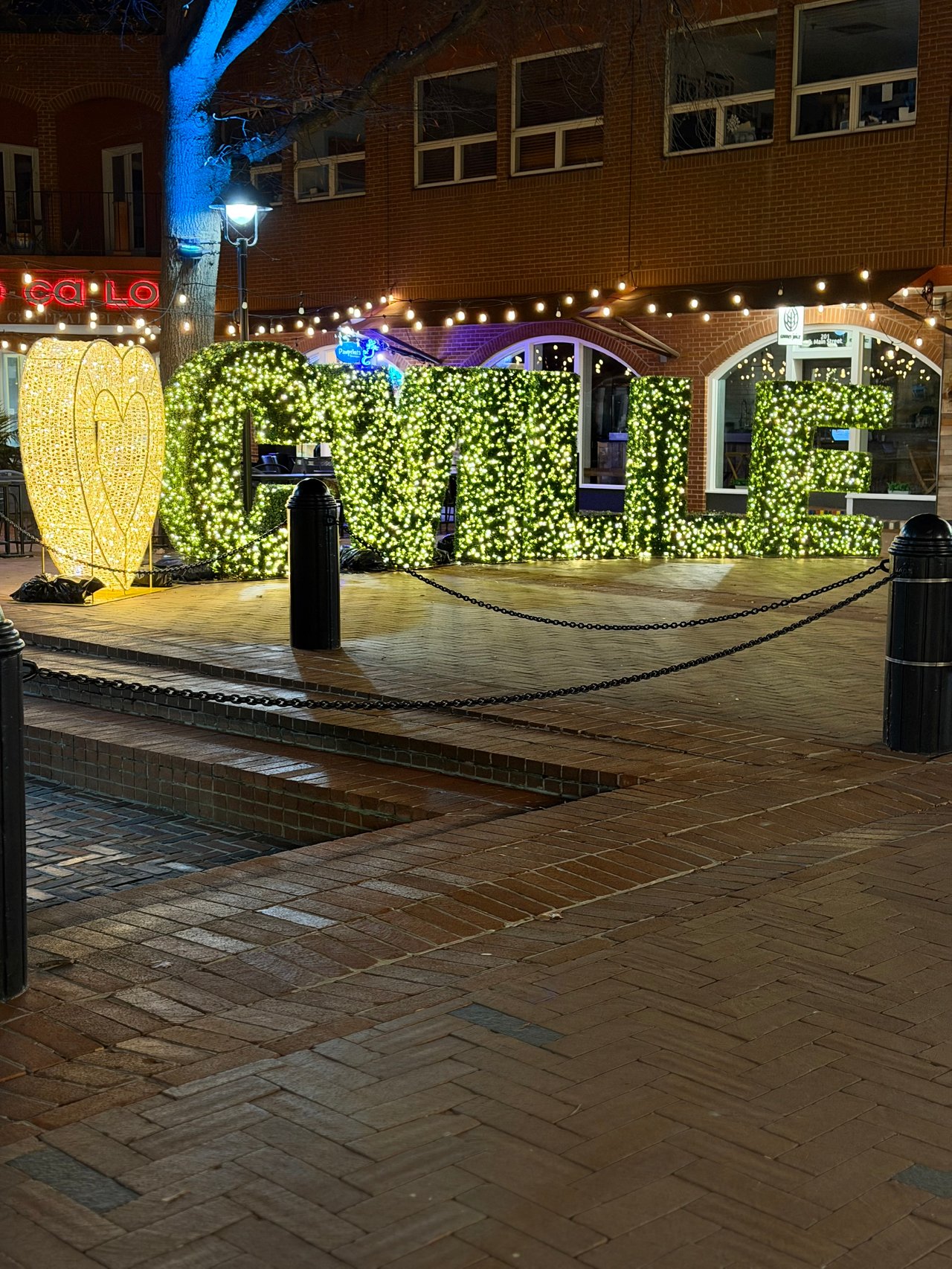
Walk the Downtown Mall right now and you'll pass two different moods within a few blocks of each other. Near the east end, banners mark the pedestrian strip's 50th year, the same brick and pin oaks that opened to the public on July 3, 1976. Head toward the west end, past the Omni, and you'll find a chain-link fence where the Artful Lodger building stood until demolition crews arrived on August 6. Nobody has said yet what goes there. An apartment complex was floated once. That's still all anyone can tell you.
That gap between celebration and construction fencing is the actual story of the Mall's 50th year, not the anniversary programming built to mark it. The bricks aren't just having a birthday. They're in the middle of a handful of quieter decisions, made by the city, by festival organizers, by a group of local teenagers, that say more about what the next decade looks like than any ribbon-cutting will.
Tom Tom's Own Anniversary Announcement
The clearest sign the Mall is at an inflection point didn't come from a press release about turning 50. It came from the organization that has spent 14 years being downtown's loudest annual argument for itself. The Tom Tom Festival built its 2026 theme, COURAGE, explicitly around this moment, timed to both the 250th anniversary of the Declaration of Independence and the Mall's own half-century mark. The five-day event in April brought more than 200 events to the pedestrian strip, and in 2025 it drew over 27,000 people. That's the scale of proof-of-concept a downtown institution points to when it wants to argue it's thriving.
Except Tom Tom's own executive director, Paul Beyer, said this may be the last year the Festival runs in its current format, and that the foundation is asking the community to help decide what comes next. That's not a footnote. A festival that size, timed on purpose to the Mall's anniversary, is telling you the format that produced its biggest numbers might not be the right one going forward.
Even at that scale, the benefit doesn't land evenly. Joan Fenton, who owns J. Fenton Too on the Mall, put it plainly to a local TV reporter after this year's Festival: as a retailer, it doesn't help her business at all, though she thinks it's good for restaurants and for the community overall. Foot traffic from an outdoor festival doesn't reliably turn into shopping bags, and Greer Achenbach, executive director of Friends of Charlottesville Downtown, has said the impact on retail depends heavily on how much a given business chooses to lean into the crowd rather than work around it. If you live here, you already know this rhythm every April: packed bricks, uneven payoff, and a shrug from half the shop owners you pass.
The Corner That's Just a Fence Right Now
Meanwhile the west end of the Mall is sitting with an open question. The Artful Lodger building's demolition began in early August, and as of this writing, the fate of the space is still under discussion. A prior plan for an apartment complex on the site never turned into anything you can point to. For anyone who walks that stretch daily, past the Omni toward the Water Street garages, the anniversary energy simply doesn't reach that corner yet. It's fencing, not festivity, and it will likely stay that way for a while.
That contrast matters more than it looks. A pedestrian mall built to be a single continuous experience, eight blocks of it, is currently two different experiences depending on which end you're standing at. One end is being marketed as historic. The other is a construction zone with an undecided future. Both are true descriptions of the same 50-year-old strip in the same month.
Why the City Swapped Out Its Leaf Blowers
The smaller, less glamorous fix might be the most telling one. On August 24, the city's Downtown Mall custodial crew officially switched to all-electric leaf blowers, retiring the gas-powered equipment that had been clearing brick and trash from the strip for years. The reason wasn't cosmetic. Tray Biasiolli, the city's climate program specialist, explained that the Mall's layout, with taller buildings pressed close on either side, turns early-morning noise and exhaust into something that reverberates and just sits there, like an echo chamber. Residents and business owners nearby had been raising it for a while.
That's the kind of maintenance decision that only gets made once a place has been operating long enough to accumulate small, cumulative frictions its original design never accounted for. Fifty years in, the Mall's architecture, brick corridor, tall storefronts on both sides, works against it in ways that only show up at 6 a.m. before the shops open. A leaf blower swap sounds minor. It's actually a small confession that the place needs upkeep decisions its 1976 planners never had to think about.
What the City Asked a Group of Teenagers
The same week, the city ran a different kind of diagnostic. Through CARELab's Mayor's Challenge, Mayor Juandiego Wade asked a group of high school and college students to look at what the Downtown Mall could become for the next generation, and their findings, released August 24, read less like a school project and more like an honest audit:
- The tourism team found the Mall comes alive for major events like Tom Tom, but not on an ordinary day. Some visitors described a one-and-done experience, and inconsistent business hours leave stretches of the Mall quiet, especially on Sundays and Mondays.
- The commerce team looked at what it actually takes to start and keep a business on the Mall, and found high rents with no real affordable path in for new entrepreneurs. Their proposal was a pipeline: maker stations and night markets first, storefronts later.
- The sustainability team proposed testing a living block, more shade, free seating, rain gardens, and cooling features, measured against real data the city already tracks: heat, stormwater, foot traffic.
None of this was commissioned as anniversary content. It reads instead like the city quietly asking itself whether the current retail model can support anyone new without an easier way in. If you've watched a storefront sit empty for a stretch, or wondered why the same shops seem to be the ones that last, this is the closest thing to an answer that's been written down this year.
What Doesn't Depend on Any of This
None of the above touches the parts of the Mall that keep running regardless of festival formats or fenced-off corners. Fridays After Five still brings a free concert to the east end every Friday through spring, summer, and fall. The Farmers Market at IX Art Park runs Saturdays, and the Starr Hill Farmers Market at the Jefferson School African American Heritage Center runs Sundays, a few blocks off the bricks but part of the same downtown rhythm. Soul of Cville returned August 10 through 16 this year, and Sin Barreras will host the Sabroso Festival at the Ting Pavilion again this September, as it has for years around Hispanic Heritage Month.
These are the fixtures that don't need a 50th-anniversary campaign to justify themselves. They're also the parts of the Mall likely to outlast whatever comes next for Tom Tom, whatever gets built where the Artful Lodger stood, and whatever the commerce team's night-market pipeline turns into, if it turns into anything at all.
That's the actual shape of the Mall's 50th year. Not a single celebration, but a strip of brick renegotiating its own terms in public, one leaf blower, one demolition permit, one homework assignment at a time. Next April's Festival will look different. The corner by the Omni won't be a fence forever. Worth watching either way, if you're the kind of person who already knows exactly which end of the Mall you'd rather be standing on this weekend.
If you're watching Charlottesville change block by block and want to talk through what any of it means for the neighborhood around you, Patricia Irby is always happy to grab that conversation over coffee.